
Master Elliott Waves
WHAT IS IT?
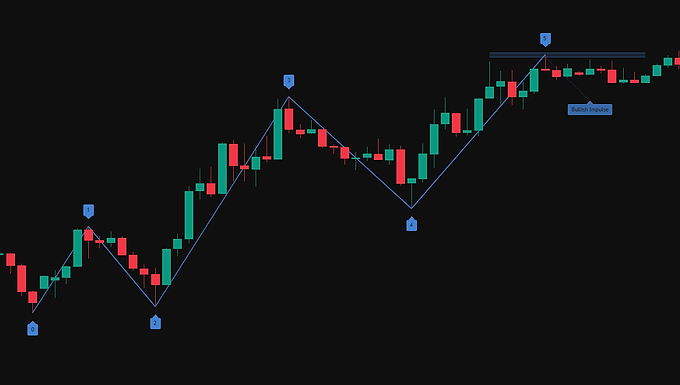
Elliott Wave Theory proposes that markets move in fractal patterns: 5-wave motive structures (impulse waves) followed by 3-wave corrective structures. Impulse waves include strict impulses and diagonals. Corrective waves include zigzags, flats, and triangles. Manual Elliott Wave labeling is highly subjective. Most automated implementations use simplistic counting with minimal Fibonacci validation.
INDICATOR PRIME IMPROVEMENTS
Master Elliott Waves uses a complete Fibonacci-validated detection engine for five pattern types. Impulse rules are strictly enforced: Wave 2 cannot exceed Wave 1, Wave 3 must extend beyond Wave 1, Wave 4 cannot overlap Wave 1 territory, Wave 3 cannot be the shortest. Diagonal detection allows Wave 4 overlap. Zigzags require B/A below 78.6%. Flats require B/A above 78.6%. Triangles require contracting structure. All patterns are scored by Fibonacci ratio precision and span. PRZ zones mark the expected completion area.
HOW TO USE
Use Elliott Waves as a contextual framework rather than a standalone entry trigger. In Wave 3 of an impulse, trend-following strategies have the highest statistical win rate. In Wave 5, watch for oscillator divergences signaling exhaustion. Corrective Zigzag and Flat patterns indicate consolidation phases where mean-reversion works better. Best on 4H and daily charts for swing trading.
KIT CONFLUENCE
Master Elliott Waves provides the highest-level structural context in the Price Action Kit. Use daily and 4H charts for wave degree context, Master Chart Patterns on 1H for intermediate structure, and Candlestick Pro on 15M for entry triggers. Smart Fibonacci Zones placed from Wave 1 high to Wave 2 low mark expected Wave 3 targets. Master Harmonic Patterns at Wave 4 and 5 boundaries are frequent setups.
Click here to get the Price Action Kit